
“Sicilians build things like they will live forever and eat like they will die tomorrow”
Sicily, the pearl of the Mediterranean sea
I’m Sicilian and the more the years I spend away from home, the more I feel a strong sense of belonging to my island.
Sicily is one of the pearls of Mediterranean together with its little Islands:
- the Aeolians,;
- the Egadi ;
- the Pelagie ;
- Pantelleria a;
- Ustica .
Fascination for this region grows with its great volcanoes, and with its archaeological sites that tell us the story of its ancient origins . Each time I make my return to it, I find it more beautiful than ever. Sicily is gorgeous, and the reasons, trivial as they may seem, are simple. Of course, it’s a great destination for you upcoming holidays. Read my post and my tips about the most interesting places where to go!
Sicily, an island of wonder
Boasting wonderful weather Sicily is an island full of history, cultural treasures, architectural gems and natural wonders with its juxtaposition of sea, volcano and mountain scenery . In only a few hours you can arrive from the sea up to the peak of 2900 meters of the Etna craters.
You eat well, of course! It is a heaven of culinary delights, and foodies, wine lovers and those with a sweet tooth will fit right in. There are endless things I can list , I have to stop, though. Together with the size of the island, the multitude of things to see and to do leads to having to choose a route over another!
For all these reasons and more besides, Sicily offers itself as a game board in which you can move the pieces as best you believe within the hospitality of the locals! I have always the beauty of Sicily with me.
History of Sicily
Sicily has an historical and cultural richness unparalleled in the world. Sicily was inhabited since prehistoric times. Three original tribes called Sicani, Elymians and Sicels were the first people who arrived in Sicily after it rose up out of the sea, and ancient writers thought they originated from Spain, mainland Italy and Greece.
Sicily is an Europe in miniature since it was invaded by: Phoenicians, Greeks, Romans, Goths, Byzantines, Arabs, Normans, French, Germans, Spaniards, Italians and British .
No doubt you have heard some stereotypes of Sicilian people that have made you question if a trip to Sicily is right for you!
Prejudices about Sicily
Are Sicilians like “The Godfather movie”? Are Sicilians going to flirt with every woman anytime and all the time? Although prejudices against Sicilians are considered by many to be more historical than contemporary, some of them still exist for reasons reaching far back in time.
Discrimination in any form has never made much sense to me, so it is difficult to say exactly why there could be a bias against Sicilians even today, other than the fact that there were historical reasons!
Sicily was the best before the Italian unity in 1861!
For example, not everyone knows that a whole series of difficulties and problems in Sicily started long ago in the period after the Italian Unity in 1861. Belonging to the “Bourbon Kingdom of the Two Sicilie”, Sicily has been an impoverished region since it was occupied by a corps of volunteers. These werec led by Giuseppe Garibaldi, from the “Savoy Kingdom of Piedmont and Sardinia” in 1860.
The “Kingdom of the Two Sicilie” lasted from 1816 until 1860, when it was annexed by the “Savoy Kingdom of Piedmont and Sardinia”, which eventually became the “Kingdom of Italy” in 1861.
Before its invasion the “Kingdom of the Two Sicilie” was the richest country of Italy . ” Savoy Kingdom of Piedmont” took all the richness of the “Kingdom of the Two Sicilie” to unify Italy. The “Kingdom of the Two Sicilie” was a grand prize for the “House of Savoy” , and for certain cosmopolitan financial interests .
The expanse of the the “Kingdom of the Two Sicilie”, with its glorious past before it was conquered, meant a home market that allowed it to industrialize in comparison to the other pre-unification states.
During the occupation, the factories of the “Kingdom of the Two Sicilie” were disassembled and relocated to Northern Italy. “Kingdom of the Two Sicilie” ‘s strong regional culture simply vanished into thin air .
“The Risorgimento” time of Sicily
The “Risorgimento” was not at all a high-minded attempt to create cultural unity, but a gigantic land-grab by the “Savoy Kingdom of Piedmont and Sardinia “.
Thus, for a number of years in the 1860s, until the annexation of Rome, itself, to the nation, there was a strong “Anti-Risorgimento Legitimist Movement” based in Rome. Her the Pope was king and where the ex-Bourbon court of Naples still conducted a government in exile, waiting to be restored.
However, the nature of the the Italian Unity became clear, with only 1% of Sicilians being entitled to vote in the new Italian Parliament! Sicily was once again the outpost of an empire, with absentee rulers. These understood little and cared less about the Sicilians who struggled to make a subsistence living from agriculture and fishing.
Over the following century, the poverty of the Sicily led to mass emigration to the United States ! The first significant wave of Sicilian immigrants to the U.S.A. began in the late 1880s! The twentieth century also started badly, marked by a disastrous earthquake in Messina in 1908, a reluctance to adapt to unification and a standing mass emigration of around 1.5 million.
The Sicilian Mafia and the II Word War in Sicily
The Mafia became an intrinsic element of life in Sicily with the Italian state unable to impose its own legal constraints. One and a half million Sicilians found their ways to the U.S.A. , and it was in the U.S.A. where they were recruited to be willing participants in the final invasion of the island during the II World War, by supplying US Intelligence with detailed information on the topography of the island, its towns, and the names of those in Sicily who would assist their cause.
In July 1943, the US Army and allied forces, under the five-star leadership of Generals Patton and Montgomery, landed at Gela and Pozzallo, respectively. They numbered over 160,000, which was larger than any invading force, at any point in Sicily’s long history!
Making use of the information gleaned from the Sicilian émigrés, the Allied Forces had advanced from the coast to the centre of the island at Enna, and then on to Messina, where they finally defeated the last of the occupying Germans.
From there, they went to take on the rest of Italy. Immediately after the II World War, the Italians held a referendum on whether to maintain or scrap the monarchy; the republicans won by a paper-thin majority. The House of Savoy went into exile from the whole of Italy.
However, Sicily was left impoverished, and with little prospect of work, the island’s inhabitants continued to leave in their tens of thousands, some still to the U.S.A. and Australia, but many travelled to the newly-industrialized northern Italian cities of Genoa, Turin, and Milan, where companies such as Piaggio scooters, Fiat cars, and Pirelli tyres, were rapidly expanding.
Despite this mass emigration, and relative lack of industrial development, Sicily has continued to maintain a degree of self-governance from the rest of Italy, and, even today, remains one of the few autonomous regions of Italy, responsible for its own agriculture, education, and industry, taxation, and sustainable tourism.
Modern Sicilians are a complex race, dispossessed for centuries: we now find ourselves custodians of our cultural and historical monuments of our oppressors, and in the strongest situation in our history.
The food of Sicily
The complex history of Sicily has left its mark in landscapes, art, and culture. But nowhere is it more evident than in the Sicilian Food :
- Greeks brought : olives and introduced to wine making;
- Romans introduced: fava beans, chick peas, lentils and some forms of pasta;
- Arabs brought: almonds, aniseed, apricots, artichokes, cinnamon, oranges, pistachio, pomegranates, saffron, sesame, spinach, sugarcane, water melon rice, raisins, pine-nuts , vegetables , fish , ice cream, granita (made with snow from Etna and other mountains), cassata, marzipan, candied fruits, farming and irrigation techniques, and distilled grape for grappa;
- Normans brought : the rotating skewer for cooking meat and air salting of fish;
- The French brought: a legacy of chefs for the aristocracy:
- The Spanish brought : many vital ingredients of the today’s Sicilian diet;
- The New World provided : chilli and sweet peppers, tomatoes, potatoes and maize.
Today, you will eat very well all over Sicily. One telling characteristic is that you will rarely eat anything that has not been produced within a few miles of where you are sitting.
The freshest fish on the coast, the tastiest meats and cheeses in the interior and a huge range of vegetables, fruit and mashrooms, all with a richness of flavour that you just don’t find at the supermarket!
The wine of Sicily
Sicilian Wine has an ancient origin today as well. According to legend, it was Dionysus (Bacchus) who brought pleasure to mankind, and wine to Sicily.
Legend aside, it is certain that wine has been made in Sicily for millennia. There is evidence that Mycenaean traders cultivated grapes in the Aeolian Islands as early at 1,500 BC and when the Greeks began to settle in Sicily in the 8th century BC, they too were unable to forgot their favourite libation “Oinos“, and introduced several varieties of vines.
The history of John Woodhouse and Whitaker
The next significant date in Sicilian wine history is 1773, the year John Woodhouse began producing what destined to become one of the island’s best loved products: Marsala. Woodhouse understood immediately that the local wine could be transformed through the addition of alcohol, that would not only fortify the wine but also help it survive the sea journey back to England .
It was an instant success with the British, and other entrepreneurs, such as Ingham and Whitaker, soon hurried out to exploit the wine’s popularity.
The Florio family and the richness of Sicily
Towards the end of the 19th century, the English dominion in Marsala-making was brought to an end by the arrival of Vincenzo Florio, one of Italy’s first tycoons, who bought up much of the land around Marsala.
“Florio winery”, though in different hands today, remains one of the best producers of Marsala and a visit of their enormous barrel-filled winery is recommended. For most of the 20th century, Sicily continued to produce enormous quantities of grapes, most of which, however, were exported to be added to wine made elsewhere in Italy.
The last 20 years have seen enormous changes to the island’s wine culture and, as the many international prizes won by Sicilian producers confirm, some of Italy’s finest wines are now being made in Sicily.
10 beautiful places to visit in Sicily. From the North East to the South West
Sicily is really and idyllic island , which brings a smile to your face face. Picture-perfect towns, amazing landscapes and food to die for!
Being the largest and one of the most beautiful islands in the Mediterranean Sea, there is so much to explore in Sicily, and deciding on which places to visit can be a challenge.
As I had one week to explore Sicily, I put together a 7-day Sicily itinerary , which turned out to be perfect! I got to see impressive historic sites, relax on beautiful beaches, and so on. Here my list of 10 beautiful places to visit in Sicily!
1. Acitrezza
Aci Trezza is a quiet, low-key seaside town just north of Catania. There’s not a lot to do here besides relax and admire the “Riviera dei Ciclopi”, but that’s more than enough to fill your day.
Like many islands in the Mediterranean, Sicily claims to be one of the destinations featured in “The Odyssey”. Namely, the coast owes its name to an Homeric legend. According to it Cyclops is believed to have lived beneath Mount Etna . And the towering black rocks, which rise out of the sea – actually great hunks of solidified lava – were thrown by the blinded Cyclops, Polyphemus, in a desperate attempt to stop Odysseus escaping.
Aci Trezza isn’t home to sandy beaches — instead, you’ll find rocky areas for perching and sunbathing. Better yet, go for a beach club built on a deck on stilts, where you can relax underneath an umbrella and walk down a staircase into the sea.
My day in Aci Trezza was a glorious one of eating “granita”, walking along the picturesque waterfornt. I had a perfect dinner at the restaurant “Il Covo Marino” . I tasted delicious oysters paired with “KiKè Fina winery” , which is my favourite Sicilian white wine.
“The Vendicari Nature Reserve” is a migrating ground for flamingos. It’ s a place that really shouldn’t be missed! It is situated on the southern-most part of Sicily’s east coast. It’s a mixture of lagoons , sand dunes, rocky coastlines, and sandy beaches.
“The Vendicari Nature Reserve” was instituted in 1984. It’s home to a wide variety of flora and fauna. The most famous beach of this reserve is called “Cala Mosche beach”. It’ s a sandy little bay that extends for about 200 meters, delimited by two rocky headlands that act as shield to the currents, with the result of an always calm and clear sea.
“Isola delle Correnti beach” is regarded as one of the most beautiful tourist attractions of Portopalo di Capo Passero and the entire Sicily.
It is linked to Portopalo by a small strip of stone and it is able to enchant you thanks to its wild and unspoiled landscape.
The island is abandoned and the unique sign of the presence of humans is a lighthouse, an evocative military structure built near the home of the lighthouse keeper. The home was inhabited in the past by the keeper’s family.
The “Isola delle Correnti beach” is so named because this is the exact point where the Ionian and the Mediterranean Sea meet.
Siracusa is a window into the ancient history of the Mediterranean and Europe. Its vast archeological site, on the edge of the modern city, is a rare treasure of temples, amphitheatres and an ancient castle.
The “Island of Ortygia” – a labyrinth of charming ancient and medieval streets – makes for a delightful holiday of sightseeing and shopping.
5. Marzamemi
Marzamemi is one of the most charming and authentic seaside villages in the south east of Sicily . It is 3 km away from Pachino, and is surrounded by the deep blue Ionian sea which creates two natural small seaports along the coast, called “Fossa” and “Balata” .
The multicoloured harbours abound with blue, red and yellow-coloured Sicilian fishermen’s boats rocking slowly over the sea.
6. Tindari
The history of Tindari is a succession of tales, myths and legends that left indelible marks in the popular imagination.
The “Sanctuary of the Madonna Nera” (“The Black Madonna”) however, is the foremost attraction in Tindari. Inside, the sculpture of the “Virgin and Child”, in citron wood, is said to have reached Tindari in an attempt by the faithful to keep it safe from the 8th-Century Byzantine Iconoclast movement.
According to legend, the statue was abandoned by the sailors of a ship moored under the promontory; otherwise they feared that to take it with them would go against divine will and prevent them from setting sail anew. Today, the “Black Madonna” is venerated every September 7th.
7. Gioiosa Marea
Gioiosa Marea is well known for its beaches, from which it’s possible to see some unforgettable sunsets over the Aeolian islands.
8. “Scala dei Turchi”
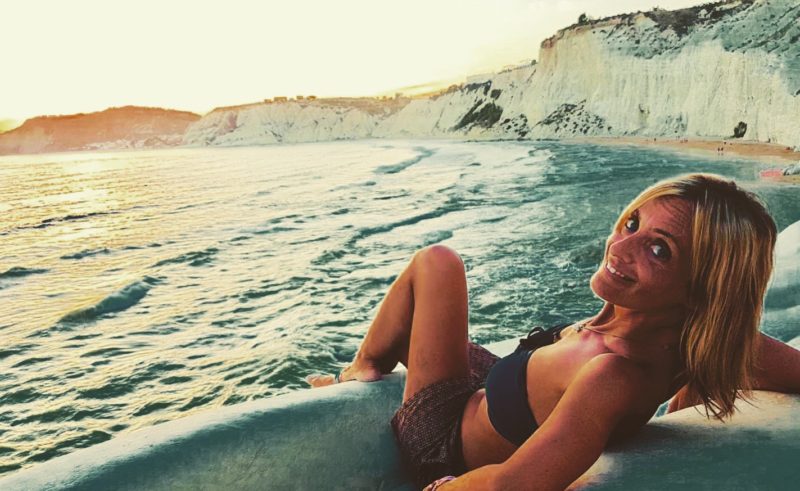
“Scala dei Turchi” is a stunning rocky cliff on the coast of Realmonte, near Porto Empedocle, Southern Sicily.
9. Sciacca
Sciacca is an historic fishing port on the southern coast of Sicily. A workaday town rather than a polished tourist destination, it is famed for its ceramics, manufacturing coral , its thermal baths and its religious festivals, as well as for its large fishing fleet.
10. Licata
Licata is my hometown. I’s a stunning city located on the south coast of Sicily, at the mouth of the Salso River , about midway between Agrigento and Gela.
Although it is now an important regional town and port, the historical center of Licata is quite compact and has many monasteries and churches that hold works of art of great artistic interest and are the highlight of your visit.
It’s a major seaport developed at the turn of the twentieth century, shipping sulphur, the refining of which has made Licata the largest European exporting centre.
Today Licata is worth visiting for many other reasons:
- The unparalleled view over the sparkling sea from its “Castel Sant’Angelo” (a 17th-century castle built as a fortress);
- The “Art Nouveau Villas” (20th century);
- The charming tourist harbour “Marina di Cala del Sole”,. Here visitors can enjoy wine and food, while admiring the millionaires’ yachts bobbing nearby;
- The prestigious restaurant “La Madia” , which is run by the Michelin chef Pino Cuttaia;
- The infinite sandy beaches that saw Allied Landings in 1943, but now attract locals and foreigners for swimming and sunbathing.
Sicily, a paradise where to live
Now, more than ever, it is time to explore and discover for yourself the unique, precious jewel that is Sicily, an island of contrasts and surprises.
Every time the sun sets down slowly, I know I always find something special in my crazy Sicily, a wild and unpredictable Island! It’s a perfect place where to go for your upcoming holidays!
If you like my post, please subscribe to the socials of www.WeLoveitaly.eu :